Intra-muros vs extra-muros: what actually changes day to day for an EU consultant
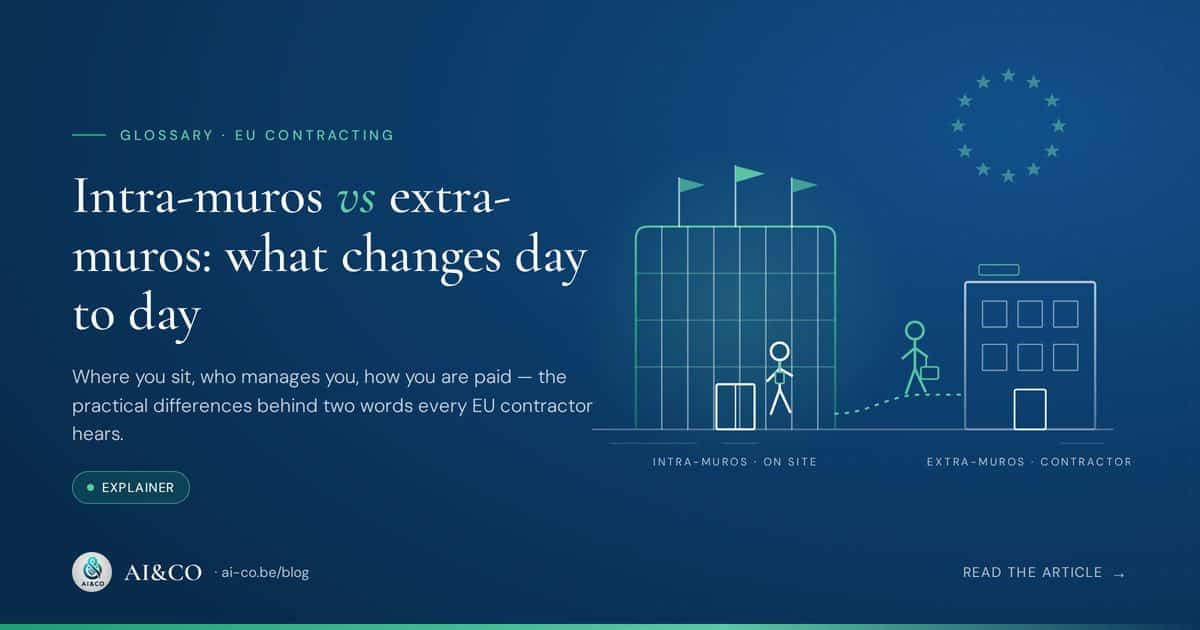
In short: intra-muros means you work inside the institution’s own premises, on its equipment, under the day-to-day direction of its staff, as part of the team; extra-muros means you work for the institution but from your supplier’s premises or remotely, managed by the supplier, delivering a service. The two words come from the Latin “within the walls” and “outside the walls”. The choice is made by the institution for each request, not by you, but it shapes your daily life: badge and building access, laptop and tools, who assigns your work, how your time is counted, how much remote work you get and how close you are to the institutional network. Here is what actually changes.
Where the terms come from
EU institutions have used the intra-muros / extra-muros distinction for decades in their procurement of IT and consultancy services. It answers a simple question: is the external person inside the walls, integrated into the institution’s premises and infrastructure, or outside the walls, delivering from elsewhere? The distinction matters for the institution for security, data protection, cost and management reasons. It matters for you because it defines your working environment. Under the Commission’s DIGIT-TM III framework contract (2026–2030) the same logic appears as “near-site” lots for Belgium and Luxembourg and a “far-site” lot for remote delivery from anywhere in the EU.
Intra-muros: inside the institution
You are physically present in the institution’s building, the Berlaymont or one of the many Commission buildings in the European quarter, a Parliament building, the Council’s Justus Lipsius or Europa, an agency in Brussels or elsewhere. You receive an institutional access badge after a security screening, an EU Login account, an institutional e-mail address and, in most cases, an institutional laptop configured with the standard tooling. You attend the team’s meetings, you use its ticketing, collaboration and development platforms, and your work is assigned and reviewed by the institution’s team leader or project manager.
Your time is counted in days worked on site (or in hybrid mode, according to the hosting DG’s teleworking rules, typically two to three remote days a week in 2026). Public holidays and closure days are those of the institution. In practice, an intra-muros consultant is a full member of the team in every respect except the employment contract, which remains with the supplier or the employer of record.
Extra-muros: outside the walls
You work for the institution but from your supplier’s offices or from home, sometimes from another EU country. The supplier manages you: it assigns tasks, organises your time and is responsible for the service delivered. You access the institution’s systems remotely, through secured channels and with an EU Login, but you usually do not hold a building badge or an institutional laptop. Contact with the institution’s staff goes through defined channels: a project manager, regular meetings, deliverables and acceptance procedures.
Extra-muros missions are more common for development, testing, data and documentation work that can be organised as a service, and they have grown with the remote-delivery lot of DIGIT-TM III. They suit consultants who do not want to relocate to Brussels or Luxembourg, or who prefer working within a supplier’s team rather than embedded in an institutional one.
What actually changes, point by point
| Intra-muros | Extra-muros | |
|---|---|---|
| Location | Institution’s premises (hybrid according to the DG) | Supplier’s premises or remote, anywhere in the EU for far-site lots |
| Who directs your work | The institution’s team leader | The supplier’s project manager |
| Access | Institutional badge, EU Login, institutional e-mail | EU Login and remote access; usually no badge |
| Equipment | Institutional laptop and tools in most DGs | Supplier’s laptop, secured connection |
| Team integration | Full: meetings, ceremonies, corridor conversations | Through defined touchpoints |
| Security screening | Required before the badge is issued | Lighter, unless classified data is involved |
| Remote work | As per the DG’s rules, typically 2–3 days a week | Often fully remote |
| Institutional network | Strong: you are visible to several DGs | Weaker: you are visible to your supplier |
| Typical profiles | Support, coordination, analysis, project management, anything user-facing | Development, testing, data, documentation, packaged services |
Which one is better for your career?
There is no universal answer, but there is a pattern. Intra-muros missions build institutional capital: you learn how the DG works from the inside, you become known to officials who move between DGs and take their trusted consultants with them, and your next mission often comes from a conversation in the building rather than from a job board. Consultants who want a long career in the European ecosystem generally prefer at least one intra-muros mission early on.
Extra-muros missions build technical depth and flexibility: you work within a supplier’s team, on delivery-oriented projects, with more control over where you live and how you organise your day. They are a good fit for developers and engineers who value autonomy over proximity, and for consultants based outside Belgium.
Three practical points people get wrong
- You do not choose. The institution defines the mode in the service request. What you can do is tell your recruiter which mode you prefer, so that you are proposed on the right requests.
- Intra-muros is not employment by the institution. However integrated you are, your contract is with the supplier or the employer of record, and the institution is not your employer. This is precisely what allows the mission to exist without an EPSO competition.
- Extra-muros is not “less serious”. Some of the most technical work for the institutions is delivered extra-muros, and the remote lot of DIGIT-TM III is worth about €1.4 billion over four years.
Frequently asked questions
What does intra-muros mean in EU institutions?
That the external consultant works inside the institution’s premises, on its equipment and under the day-to-day direction of its staff, as an integrated member of the team, while remaining employed by a supplier or an employer of record.
What does extra-muros mean?
That the consultant works for the institution from the supplier’s premises or remotely, managed by the supplier, delivering a service to the institution.
Can I choose between intra-muros and extra-muros?
The mode is fixed by the institution in each service request. You can state your preference to your recruiter so that you are proposed on matching requests.
Is intra-muros work hybrid?
Usually yes in 2026: on-site presence is combined with remote days according to the rules of the hosting Directorate-General.
Does intra-muros pay more?
Not by itself. Rates depend on the profile and level defined in the framework contract, not on the mode; on-site presence in Brussels may however be reflected in the request’s conditions.
Next step
Each mission on our missions page shows its work mode, on site, hybrid or remote. If you know which mode suits you, say so when you submit your profile: it helps us propose you on the right requests from the start.
Ready for your next institutional mission?
Submit your profile — a member of our team reads it personally and replies within 5 business days.